Boats don't have VINs. They have a HIN, a 12-character hull identification number, and that is the number every "boat VIN lookup" actually runs on. Every boat built or imported into the US since 1 November 1972 should carry one. You can decode it for free, check it for recalls for free, and for larger boats look it up in a Coast Guard register for free. What you can't get for free is the boat's full ownership and accident history. This guide walks through what each free check shows, where it stops, and when a paid report is worth it.
Is a boat VIN the same as a HIN?
For practical purposes, yes. A car's VIN is 17 characters and is issued under federal motor vehicle rules. A boat's number is a HIN, issued by the builder under Coast Guard rules (33 CFR 181, subpart C). Dealers, insurers and state forms often say "VIN" anyway. Hawaii's boating division writes on its own insurance page that a HIN "is equivalent to the Vehicle Identification Number or VIN on an automobile." If a form or a seller asks for the boat's VIN, they mean the HIN.
Three other numbers get mixed up with it, and none of them identify the hull:
| Number | Where it is | What it identifies |
|---|---|---|
| HIN | Stamped on the starboard side of the transom | The hull itself, for life |
| Registration number | Painted on the bow, e.g. FL 1234 AB | The current state registration |
| Engine serial number | A tag on the outboard or sterndrive | The engine, which can be swapped |
| Trailer VIN | The trailer tongue or frame | The trailer, a separate vehicle |
A boat sold as a package can have three identities: hull, engine and trailer. Each one needs checking on its own.
What the 12 characters mean
The format is set by federal rule. A HIN has twelve characters with no spaces or dashes:
- Characters 1 to 3: the manufacturer identification code (MIC), assigned by the Coast Guard.
- Characters 4 to 8: the builder's own serial number. The letters I, O and Q are not allowed.
- Character 9: the month of build, A for January through L for December.
- Character 10: the last digit of the build year.
- Characters 11 and 12: the model year.
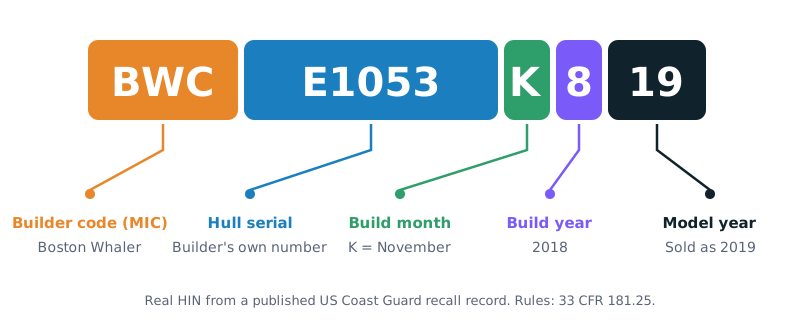
Here is a real one from a published Coast Guard recall record, BWCE1053K819. BWC is Boston Whaler. E1053 is the hull serial. K819 means built in November 2018 and sold as a 2019 model. A build month late in the year with the next model year is normal; builders start the new season in the autumn. How to read a boat HIN covers the older pre-1984 date formats.
Where to find the HIN
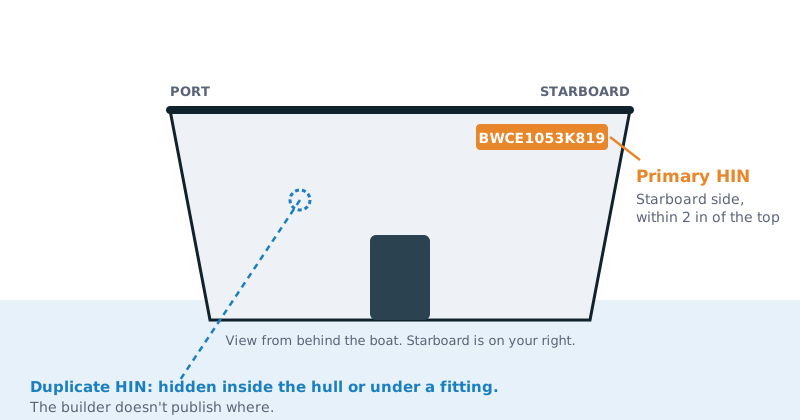
The rule puts the primary HIN on the starboard (right, facing forward) outboard side of the transom, within two inches of the top. Boats without a usable transom carry it on the starboard hull side near the stern. The characters must be at least a quarter of an inch high. A second, duplicate HIN is fixed somewhere hidden inside the boat or under a fitting, and the builder doesn't publish where. Where is the HIN on a boat has the details, including pontoons and jet skis.
The free boat VIN lookups that exist
No single free site gives you a boat's complete history, whatever the search ads promise. You get there by running a few separate checks, each answering one question.
1. Decode it: is the number real, and does it match the listing?
Type the HIN into the free HIN decoder. It reads the builder from the first three characters, the build month and year, and the model year, and it flags a number that doesn't follow the format. Compare the result with the ad. If a "2015 Sea Ray" decodes to a different builder or a 2009 model year, ask about it before you go any further. You can also look up any three-letter code directly in the Coast Guard's manufacturer identification database.
2. Recalls: has the builder had safety campaigns for that model year?
The Coast Guard keeps a public database of recall campaigns for boats and boating equipment. Our boat recall check searches it by HIN and lists the campaigns on record for that builder. A match tells you a campaign exists for that builder and year. It does not tell you whether that particular hull was affected or whether the work was done, so ask the seller for paperwork and confirm with a dealer.
3. Documentation: is it a Coast Guard documented vessel?
Larger boats (generally five net tons and up, which in practice means many boats over about 25 feet) can be federally documented instead of state registered. Documented vessels are listed in the Coast Guard's PSIX vessel search, which you can search by hull identification number. A hit gives you the vessel name, official number and documentation details. If the seller says the boat is documented and PSIX has nothing under that HIN, ask why.
4. Registration and title: does the paperwork match the hull?
State registration and title records aren't searchable by the public in most states, and owner names are generally kept private. The free version of this check is physical. Read the HIN on the transom, then read the HIN on the title and registration, and make sure they match character for character. Then check that the seller's ID matches the name on the title. Boat title vs HIN explains what a clean title does and doesn't prove.
5. Stolen: is it reported stolen?
The national stolen property file is open to law enforcement, not to the public. The practical check is a call to the local police, sheriff's marine unit or state wildlife agency with the HIN. Many will run it for a buyer. Be wary of a HIN plate that looks newer than the boat, a sticker where there should be a stamp, grinding marks or filler on the transom, or a seller who can't produce a title.
What a free lookup can't tell you
Every free check above reads either the number itself or a public register. None of them shows:
- Accidents, sinkings or insurance total losses
- Hurricane or flood damage
- Liens recorded in another state
- How many owners it has had, and in which states
- Odometer-style engine hours (boats have no federal hour records at all)
That information sits with insurers, salvage auctions, lenders and state agencies, and paid history services buy access to it. For a cheap boat a decode, a recall check and a careful look at the paperwork may be enough. For anything where a hidden total loss would hurt, a paid boat history check is cheap insurance. A marine survey is still the only way to learn the boat's actual condition.
HIN red flags before you buy
- It isn't 12 characters, or it has spaces or dashes on a post-1984 hull.
- The serial section (characters 4 to 8) contains I, O or Q.
- The builder code decodes to a different company than the one in the ad.
- The model year is more than a year after the build year.
- The transom HIN and the hidden HIN don't match, or the seller won't let you look.
- The number on the title differs by even one character.
One wrong character is usually a misread (0 and O, 1 and I, 8 and B). Several together is a reason to walk away.
Common questions
Can I find the owner of a boat by its HIN?
Not from a public website in most states. Owner details are held by the state registration agency and are generally released only to the owner, law enforcement or under specific legal grounds. For a documented vessel, PSIX shows the vessel record, not personal contact details.
Do jet skis and pontoons have HINs?
Yes. Personal watercraft are boats under the federal rules and carry a HIN, usually at the back of the hull. On pontoons with replaceable hulls the HIN goes on the aft crossbeam near the starboard pontoon. See the Sea-Doo HIN decoder and the Bennington pontoon decoder.
What about boats built before 1972?
Boats built before 1 November 1972 may have no HIN or a builder's own serial format. States handle these case by case. Ask the state registration agency, which can assign a HIN if the boat needs one.
Can a HIN be changed?
Not by the owner. A replacement HIN has to be issued through the state agency, and no two boats may legally share one. A boat whose HIN looks altered should be checked with the state before any money changes hands.
Check the boat, not just the listing
Type the 12-character hull number from the transom. The decoder reads the builder, build month and model year, and the recall lookup lists any US Coast Guard recall campaign on record for that manufacturer. Free, no account.